

Could inflation derail your female clients’ retirement plans after divorce?
According to research published by Now: Pensions (26 March 2026), on average, women in the UK retire with total pension savings worth nearly 55% less than men.
There are many reasons for this gender pensions gap, including:
- Women earn less on average per hour than men (the gender pay gap).
- Women are more likely to work part-time or reduce working hours after having children.
- Women who take career breaks for unpaid care may halt or reduce pension contributions.
Divorce can widen this gap further. A survey by Legal & General (2 April 2025) reveals that women’s incomes are cut in half following a separation. They’re also more likely to waive rights to a partner’s pension as part of a divorce settlement (28% compared to 17% of men). As a result, many of your female clients may have less retirement provision and less capacity to rebuild savings after divorce.
Moreover, UK inflation has remained largely above the Bank of England’s 2% target since mid-2021. The most recent figures from the Office for National Statistics (21 October 2026) show the Consumer Price Index (CPI) at 3.5% as of September 2026. For women who have already seen their retirement pot shrink after divorce, this “sticky” inflation could reduce the purchasing power of these funds further.
That’s why it’s increasingly important for divorced women to consider inflation when making long-term financial plans.
Read on to discover three practical ways your divorced female clients could protect their retirement wealth from inflation.
1. Invest for long-term growth
Following divorce, your female clients may feel anxious and uncertain about their financial futures. This could lead them to “play it safe” by keeping all their retirement savings in cash, rather than investing some of it.
Indeed, research by Boring Money (5 March 2025) shows that just 24% of women in the UK invest compared to 39% of men.
Unfortunately, relying too heavily on cash savings could make it harder for women to accumulate the wealth they need for the retirement lifestyle they want.
That’s because even modest levels of inflation can erode the purchasing power of cash over time. In other words, your clients’ cash may not stretch as far as they expect it to in retirement. This is a particularly pertinent consideration for women who have longer average life expectancies than men.
In contrast, if your clients invest a proportion of their savings in the stock market, this could give their wealth greater potential to grow over the long term, helping to offset the effects of inflation.
The chart below illustrates the historical growth of an initial £10,000 held in cash savings or invested in global equities between 31 March 1996 and 31 March 2026. While the blue line (stock market) shows less consistent performance, over the longer term it significantly outperforms cash savings. Although investment values can fall as well as rise, past performance is no guarantee of future returns.
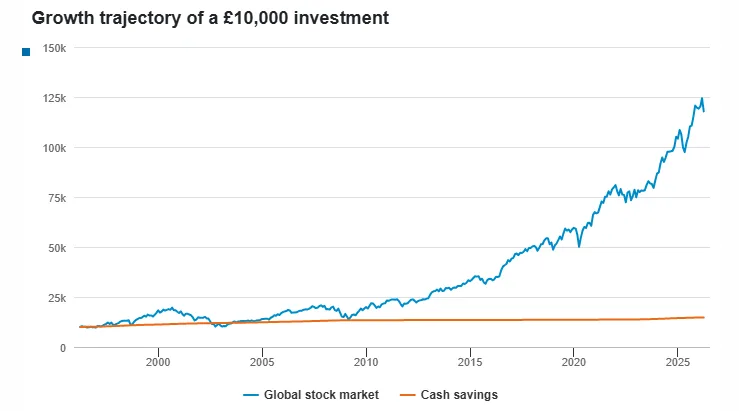
Source: Fidelity (24 April 2026). Based on total return of MSCI All Country World Index and Morningstar UK Savings 2500, a UK savings index built from the average savings rate of 20 bank and building society accounts.
Encouragingly, HSBC (8 March 2025) reveals that high-earning women are closing the gender investment gap. Nearly half (48%) of women who earn more than £100,000 a year report investing regularly, with many saving and investing more than men each month.
2. Diversify investments
Different investments respond differently to inflation, interest rates and wider economic conditions. Diversification (spreading money across different asset types) can reduce reliance on any one asset type, although it cannot eliminate risk.
A financial expert can guide your female clients to diversify their investments in a way that reflects their time horizon, income needs, attitude to risk, and capacity for loss.
Of course, no investment is risk-free or entirely inflation-proof. However, for recently divorced women rebuilding retirement savings, diversification could help balance the need for long-term growth with the desire to avoid taking on more risk than they’re comfortable with.
It’s also important to note that cash remains important for emergencies and planned spending, particularly for clients facing house purchases, legal costs, or other expenses following divorce. Investment decisions should distinguish these needs from money available for the longer term.
3. Make the most of tax-efficient wrappers
When inflation remains higher for longer, investment returns can face a double squeeze: rising prices reduce the purchasing power of any gains, while tax can erode the return further.
Using tax-efficient wrappers such as ISAs and pensions may help your divorced female clients keep more of their investment growth and income working towards their retirement goals.
ISAs
Individual Savings Accounts (ISAs) allow qualifying savings and investments to grow free from Income Tax and Capital Gains Tax (CGT). The overall annual ISA allowance for contributions is £20,000 per person each tax year.
While the former chancellor, Rachel Reeves, had proposed reducing the annual Cash ISA contribution limit to £12,000 from 6 April 2027, this plan was scrapped by Chancellor John Healey in the 28 October Autumn Budget.
Read more: Your 2026 Autumn Budget update and what it means for you
Pensions
Eligible personal pension contributions can benefit from tax relief, subject to relevant limits. How that relief is received depends on the pension arrangement and the individual’s circumstances. Higher- and additional-rate taxpayers using relief-at-source arrangements may need to claim further relief from HMRC.
Another advantage of boosting pension savings is that wealth held inside a pension grows free from CGT and Income Tax.
As such, pensions can be a valuable way for women to grow their retirement fund after divorce.
Get in touch
If you would like to learn more about how I can support your divorced female clients to safeguard their retirement wealth from inflation and build long-term financial security, please get in touch.
Email lottie@truefinancialdesign.co.uk or call 07824 554288 today.
Please note
This article is for general information only and does not constitute advice. The information is aimed at individuals only.
All information is correct at the time of writing and is subject to change in the future.
Please do not act based on anything you might read in this article. All contents are based on our understanding of HMRC legislation, which is subject to change.
The Financial Conduct Authority does not regulate tax planning.
A pension is a long-term investment not normally accessible until 55 (57 from April 2028). The fund value may fluctuate and can go down, which would have an impact on the level of pension benefits available. Past performance is not a reliable indicator of future performance.
The tax implications of pension withdrawals will be based on your individual circumstances. Thresholds, percentage rates, and tax legislation may change in subsequent Finance Acts.
The value of your investments (and any income from them) can go down as well as up and you may not get back the full amount you invested. Past performance is not a reliable indicator of future performance.
Investments should be considered over the longer term and should fit in with your overall attitude to risk and financial circumstances.
Approved by 2Plan wealth management Ltd on: 9/11/26
True Financial Design Ltd is an appointed representative of 2plan wealth management Limited, which is authorised and regulated by the Financial Conduct Authority.